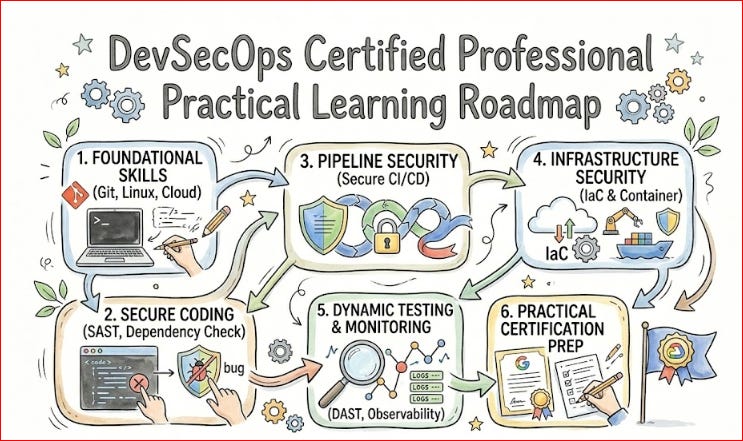
DevSecOps Certified Professional Practical Learning Roadmap
A practical roadmap to build secure CI/CD pipelines and grow your DevSecOps career with confidence.
Introduction
Security is no longer something we add at the end of software development. Today, security must be built into every step — from planning to coding, testing, deployment, and monitoring. This is where DevSecOps becomes very important. If you are working in DevOps, cloud, security, or software engineering, and you want to grow your career in secure automation, then the DevSecOps Certified Professional (DSOCP) certification can be a strong step forward.
In this blog, I will explain everything clearly:
What this certification is
Who should take it
What skills you will gain
Real-world projects you can handle
Common mistakes people make
What to do next after this certification
Career paths you can follow
What is DevSecOps Certified Professional (DSOCP)?
The DevSecOps Certified Professional (DSOCP) is an advanced certification focused on integrating security into DevOps pipelines.
It teaches you how to:
Build secure CI/CD pipelines
Automate security testing
Protect cloud infrastructure
Manage vulnerabilities
Apply security policies in DevOps environments
This certification helps professionals understand how to shift security left — meaning security starts early in the development lifecycle, not at the end.
Who Should Take This Certification?
This certification is ideal for:
DevOps Engineers
Security Engineers
Cloud Engineers
SREs (Site Reliability Engineers)
Software Developers
Infrastructure Engineers
IT Managers
Technical Architects
If you already work in DevOps or security and want to combine both skills, this certification is perfect for you.
It is also good for professionals who want to move from traditional security roles into cloud and DevOps environments.
Skills You Will Gain
After completing this certification, you will gain strong practical skills in:
Secure CI/CD pipeline design
DevSecOps tools integration
Static Application Security Testing (SAST)
Dynamic Application Security Testing (DAST)
Container security
Kubernetes security
Infrastructure as Code (IaC) security
Cloud security best practices
Secrets management
Vulnerability management
Compliance automation
Security monitoring and logging
Risk assessment in DevOps environments
You will not just learn theory. You will understand how security works in real production environments.
Real-World Projects You Should Be Able to Do After This Certification
After completing DSOCP, you should be able to:
Design a secure CI/CD pipeline using tools like Jenkins or GitHub Actions
Integrate SAST and DAST tools into the pipeline
Secure Docker containers and Kubernetes clusters
Implement security scanning in Infrastructure as Code
Configure automated vulnerability scanning
Apply role-based access control (RBAC) in cloud platforms
Manage secrets securely using vault tools
Implement DevSecOps in AWS, Azure, or GCP
Automate compliance checks
Monitor security events in production systems
These are real skills that companies need.
Common Mistakes People Make in DevSecOps
Many professionals misunderstand DevSecOps. Here are common mistakes:
Thinking DevSecOps is only about tools
Adding security only after development is complete
Not automating security checks
Ignoring container security
Not securing Infrastructure as Code
Focusing only on compliance, not real risk
Poor collaboration between security and DevOps teams
Not monitoring production environments
DevSecOps is about culture, automation, and shared responsibility — not just installing scanning tools.
Best Next Certification After DSOCP
After completing DevSecOps Certified Professional, you can grow further in different directions depending on your career goal.
Here are some strong next steps:
Advanced Cloud Security Certifications
Kubernetes Security Certifications
Site Reliability Engineering Certification
Security Architecture Certifications
Leadership or DevOps Management Certifications
Your next move depends on your long-term career goal.
Choose Your Path – 6 Career Learning Paths
Here are six structured paths you can follow after DSOCP:
1. DevOps Path
Start with DevOps fundamentals
Move to advanced CI/CD
Learn Infrastructure as Code
Then specialize in DevSecOps
Move toward DevOps Architect
This path is ideal if you want to become a DevOps Architect or Platform Engineer.
2. DevSecOps Path
Start with DevOps basics
Add security fundamentals
Complete DevSecOps Certified Professional
Advance into Cloud Security
Move toward Security Architect
This path is ideal if you want to become a DevSecOps Engineer or Security Architect.
3. SRE Path
Learn DevOps automation
Understand monitoring and observability
Focus on reliability engineering
Add security automation
Move into senior SRE or Reliability Architect
This is perfect for engineers who love system stability and uptime.
4. AIOps / MLOps Path
Learn DevOps automation
Understand machine learning basics
Apply automation to ML pipelines
Secure ML pipelines
Move into MLOps or AI Platform roles
This is ideal for professionals working in AI-based systems.
5. DataOps Path
Learn data pipeline automation
Apply DevOps principles to data engineering
Secure data pipelines
Focus on compliance and data governance
Good for data engineers and analytics professionals.
6. FinOps Path
Learn cloud cost optimization
Understand cloud governance
Apply security and compliance controls
Move toward cloud financial management roles
Best for professionals focused on cloud cost management.
Next Certifications to Take
Here are 3 smart options after DSOCP:
1. Same Track (Deep Specialization)
Advance into advanced DevSecOps or Cloud Security certifications.
2. Cross-Track (Broader Skillset)
Move into SRE or Kubernetes certifications to expand your technical strength.
3. Leadership Track
Move into DevOps Manager or Cloud Architect certifications if you want leadership roles.
FAQs – DevSecOps Certified Professional (DSOCP)
1. Is this certification beginner-friendly?
It is better suited for professionals who already understand DevOps basics.
2. Do I need coding knowledge?
Basic scripting knowledge helps, but deep programming is not mandatory.
3. Is cloud knowledge required?
Yes, basic understanding of AWS, Azure, or GCP is helpful.
4. Is this certification tool-specific?
No, it focuses on concepts and practical implementation across tools.
5. Does it include hands-on labs?
Yes, it focuses strongly on practical implementation.
6. Is DevSecOps in demand?
Yes, companies are actively hiring DevSecOps professionals due to rising security threats.
7. Can developers take this certification?
Yes, especially developers who want to understand secure coding and CI/CD security.
8. Will this certification help in salary growth?
Yes, security-integrated DevOps roles are highly valued in the market.
Why Choose DevOpsSchool?
DevOpsSchool has strong industry-focused training programs designed for working professionals.
Here’s why many professionals choose DevOpsSchool:
Real industry-focused curriculum
Practical hands-on sessions
Experienced trainers
Live project exposure
Structured learning roadmap
Career guidance support
The certification is not just about passing an exam. It focuses on building practical DevSecOps expertise that companies look for.
Conclusion
Security is no longer optional in modern software development. Every organization today needs professionals who understand how to build secure, automated, and scalable systems. The DevSecOps Certified Professional (DSOCP) certification helps you combine DevOps speed with strong security practices. It prepares you to design secure pipelines, protect cloud infrastructure, and automate security checks in real-world environments.